"The Kingdom That Has No End"
Notes
Transcript
Every December when our girls were younger, Yvette and I would vacation with other families from our church, and for reasons still unknown to me, I was always chosen as the lead driver in our caravans. I don’t know if they believed I had a supernatural sense of direction or if they just wanted someone to blame when we got lost—but either way, I was the guy in front.
And I depended on GPS like it was Scripture. And I’ve learned: when you’re following someone, you’re trusting their rule over the route.
Well, on one particular trip, the family in the car behind us had reached a, hum… well, let’s call it a “code red biological emergency.” They were desperate. And just when hope felt lost, they saw it—bright lights of a city up ahead. Civilization. Restrooms. Salvation.
But then… they saw my blinker.
Their hearts lifted with hope, and then I turned off the highway to bypass the city altogether.
I learned later that the level of discouragement in that following vehicle was deep…spiritual even. The dad told me, “Dan, when I saw your blinker, I questioned everything I believed about you.”
Because when you’re following someone, the direction they take matters. And when you’re desperate for relief, seeing light in the distance only to get rerouted is heartbreaking. That’s what makes Matthew 2 so bracing: it isn’t just about a journey. It’s about who gets to be king over the route of your life.
Now imagine the Magi—traveling hundreds of miles, guided by a star, were convinced that God was leading them somewhere meaningful. They saw a light in the sky and followed. They expected a palace, a king, and a clear destination. They expected certainty.
Instead, they arrived in a city where the king didn’t know the true King had arrived. Instead of clarity, they found confusion. Instead of celebration, they found fear. Instead of joy, they found the darkness of a ruler who felt threatened.
And suddenly, their journey wasn’t simple anymore.
We’ve spent Advent tracing the arrival of Jesus through four themes:
Week 1: The promise of his coming — God keeps his word.
Week 2: The surprise of his arrival — he shows up where we least expect.
Week 3: The joy of his presence — he brings joy to ordinary people in dark places.
Promise. Arrival. Presence. Now: reign.
But here, in the final passage, Matthew shows us that when the King arrives, not everyone responds the same way.
For the Magi, the news drew them in.
For Herod, the news shut him down.
Both heard the same message. Both saw the same Scripture. Both knew a King had come.
But one group responded with worship, and the other with fear.
This is where Advent confronts us—and where your story and mine meet the text:
When Jesus arrives, we must decide how we will respond.
Because Jesus does not simply bring comfort; he brings a kingdom. And every kingdom demands a response. When we say Jesus reigns, we mean he has rightful authority over my life—my decisions, my loves, my fears—because he is Lord.
Will we welcome the King with joy—like the Magi?
Or pull back in fear—like Herod?
That’s the tension Scripture places before us. And that’s where we begin.
Christ’s kingdom welcomes the nations
Christ’s kingdom welcomes the nations
Matthew opens this story with a shock:
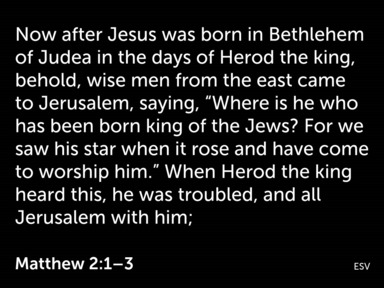
Matthew 2:1 “Now after Jesus was born in Bethlehem of Judea in the days of Herod the king, behold, wise men from the east came to Jerusalem…”
The first worshipers Matthew highlights are not priests, rabbis, or faithful Israelites.
They are Magi—Gentiles, astrologers, scholars from a distant land.
Everything about them screams outsider.
They didn’t grow up with Scripture.
They didn’t belong to God’s covenant people.
They didn’t share Israel’s history, traditions, or expectations.
Yet they were the ones who recognized the newborn King.
This is not accidental. It is theological.
Matthew is announcing from the very beginning: Christ’s kingdom is bigger than Israel’s borders, bigger than cultural expectations, and bigger than human categories.
It is a kingdom for the nations—for all peoples, tribes, and languages. And the first people who kneel before Jesus are a foreshadowing of Revelation 7, where every nation gathers before the Lamb.
That means this room matters—oilfield families, teachers, retirees, college students, folks who grew up in church, folks who didn’t. The King is gathering a people bigger than any one story.
Think about this: The King of the Jews is worshiped first by people who aren’t Jewish.
This is God’s way of saying, “My grace reaches farther than you think. My kingdom is wider than you imagine. My welcome goes deeper than your assumptions.”
And this speaks right into our moment as a church.
Some of you grew up in church; some of you didn’t.
Some of you carry long histories of faith; some carry long histories of wounds.
Some feel like insiders; some feel like outsiders.
Some feel spiritually confident; some feel spiritually confused.
But the Magi remind us:
Christ’s kingdom welcomes people who didn’t grow up close.
Christ’s kingdom welcomes people who still have questions.
Christ’s kingdom welcomes people who take a long road to get there.
The Magi also show us something else: They weren’t drawn by their greatness; they were drawn by God’s guidance.
They didn’t find Jesus because they were good at directions—as my family has learned, not everyone on a road trip is.
They found him because God was drawing them.
God set the star.
God stirred their hearts.
God pulled them closer with every mile.
And some of you are here like that—showing up, listening, asking, taking steps. You don’t have it all solved, but you’re moving toward Jesus.
In the same way, no one comes to Christ by accident—not in Bethlehem, not in Jerusalem, and not in Midland, Texas.
Every salvation story is a “star in the East”—a sign of God’s initiative, God’s pursuit, God’s welcoming grace.
So when we see the Magi kneeling before Jesus, we are seeing a preview of what God is doing here: drawing people from different backgrounds, different wounds, and different journeys…into one kingdom that has no end.
Christ’s kingdom welcomes the nations.
Christ’s welcome includes you.
And Christ’s kingdom is opening its doors wide—right here, right now.
Christ’s kingdom exposes our fears
Christ’s kingdom exposes our fears
After the Magi ask where the newborn King is, Matthew writes a striking sentence: Matthew 2:3 “When Herod the king heard this, he was troubled, and all Jerusalem with him;”
The news that brought joy to the Magi brought fear to Herod.
Same message. Different response.
Why? Because Christ’s arrival always reveals what’s happening inside the human heart.
Herod was a man obsessed with control. He built fortresses, executed rivals, and orchestrated his entire life to maintain authority. So when he heard, “A king has been born,” it wasn’t good news. It was a threat.
And before we shake our heads at him, we should recognize something: Every heart has a little Herod in it. Herod isn’t just a villain in the story—he’s a mirror. Whenever I insist “my way,” I’m crowning myself.
When Jesus arrives as King—not as consultant, not as mascot, not as accessory—his presence presses on our fears:
• What will Jesus rearrange in my life?
• What will I have to release?
• What part of my identity is he going to rewrite?
• What hurt will he ask me to bring into the light?
And for a church still healing from leadership wounds, relational fractures, and seasons of uncertainty, fear makes sense.
Fear of being hurt again.
Fear of trusting too soon.
Fear of change.
Fear of letting go of what feels safe.
In Midland, we’re used to volatility—the market goes up, then down; companies open, then close; neighborhoods grow, then plateau. So we hold things with a tight grip because we’re used to things shifting beneath our feet.
But Herod teaches us something: A tight grip is the enemy of joy.
The Magi opened their hands and found joy.
Herod clenched his fists and found turmoil.
And look how Matthew explains what happens next. Herod gathers the chief priests and scribes—the Bible experts—and asks where the Messiah is to be born. They quote Micah 5:2: “From Bethlehem will come a ruler who will shepherd my people Israel.”
The irony is breathtaking. The religious scholars know the Scriptures. They can quote chapter and verse. They know the King has come. But they don’t go to Bethlehem. They knew the right answer, but they didn’t want the right King.
Fear doesn’t always look like hostility. Sometimes it looks like passivity. A faith that knows the truth but won’t move toward the truth. Some of us in the room aren’t hostile toward Jesus—we’re just hesitant. Hesitant because of past wounds. Hesitant because surrender feels costly. Hesitant because letting Jesus lead means releasing control.
But hear this clearly: Jesus does not expose our fears to shame us. He exposes our fears to free us. Jesus puts his finger on what we’re clinging to—not to shame us, but to free us.
And the question Matthew is pressing toward us is this:
Will we cling to control like Herod… or follow the King like the Magi?
Christ’s kingdom transforms those who seek Him
Christ’s kingdom transforms those who seek Him
After Herod dismisses them, the Magi continue their search. Matthew writes: Matthew 2:9-10 “And behold, the star that they had seen…went before them until it came to rest over the place where the child was. When they saw the star, they rejoiced exceedingly with great joy.”
Matthew is piling words on top of each other—rejoiced, exceedingly, great joy—to make one point unmistakable: Those who move toward Jesus don’t walk away the same.
The Magi have traveled long miles through unfamiliar lands. They’ve navigated without road signs, without Buc-ee’s, without Google Maps. They’ve endured uncertainty, inconvenience, and danger. But when they finally stand where Jesus is—joy erupts.
And then comes the moment that reveals a transformed heart: Matthew 2:11 “…they fell down and worshiped him...”
Think about who these men were.
Educated. Wealthy. Influential.
People in their world bowed to them, not the other way around. But when they encounter Jesus—even as a child—they kneel. They bow to a baby who cannot yet walk, because they see a King who will reign forever. They’re not just seeing a baby—they’re bowing to the rightful King.
This is what genuine worship does. It moves us from curiosity to surrender. From “What is God doing?” to “Here I am, Lord.”
In Midland, we tend to respect strength—strong leaders, strong families, strong work ethic, strong independence. But the Magi show us that the strongest people in the kingdom of God are those willing to kneel.
And Matthew tells us how they kneel: with gifts. Gold (royalty). Frankincense (deity). Myrrh (sacrificial death).
Whether they understood it or not, their gifts proclaimed the identity of Jesus—King, God, Savior. Matthew doesn’t pause to explain the gifts, but the church has long noticed how fitting they are for who Jesus is.
But here’s the bigger truth: Their offering wasn’t transactional. It was transformational.
They weren’t paying Jesus. They were surrendering to Jesus.
The greatest gift they gave wasn’t the gold—it was their obedience. Their worship. Their recognition that the true King had come.
And look how the passage ends: “Being warned in a dream not to return to Herod, they departed to their own country by another way.”
They literally went home another way. But spiritually? They went home a different people.
This is always what happens when we seek Jesus with open hearts.
We leave differently. We walk differently. We love differently. We forgive differently. We serve differently.
We live under a new allegiance, a new joy, a new King.
The Magi show us that Christ’s kingdom does not merely invite us to admire Jesus—it invites us to be transformed by him.
Those who seek him are changed by him. And those who bow to him rise with joy.
Christ’s kingdom reorders our loyalties
Christ’s kingdom reorders our loyalties
Matthew ends the passage with a detail that is easy to read past but impossible to ignore: Matthew 2:12 “And being warned in a dream not to return to Herod, they departed to their own country by another way.”
The Magi have already bowed before Jesus. They have already offered gifts. They have already expressed joy. But Matthew shows us that the work of God in their hearts is not complete until one more thing happens:
They obey.
They choose allegiance.
They mark a new direction.
And this is the quiet, often uncomfortable truth of the kingdom: Christ doesn’t just change our hearts—he redirects our lives. He reorders our loyalties.
The Magi had come to Jerusalem as people under Herod’s political authority. If a king assigns a task, you fulfill it. If a king demands information, you return with answers. That’s how kingdoms work.
But after meeting Jesus, they are no longer people who take orders from Herod. They are people who take orders from God.
Their obedience is simple but profound: “They departed by another way.”
A different route. A different authority. A different allegiance.
And this is exactly what it means to belong to a kingdom with no end. Where Jesus reigns, our loyalties shift.
In Midland, loyalty is a big deal. Loyalty to family. Loyalty to friends. Loyalty to the company that gave you your start. Loyalty to your team—yes, even when the Cowboys break your heart again.
But the kingdom of Jesus calls us to a deeper, greater loyalty—one that shapes every other one: Jesus first. Jesus above. Jesus over everything else.
For a church healing from past wounds, this is vital. When loyalties have been misdirected—toward personalities, preferences, or patterns of the past—Jesus calls us back to one primary allegiance: Not loyalty to a leader, but loyalty to the Lord.
Not loyalty to how things used to be, but loyalty to the King who is making all things new.
And notice something encouraging: God does not ask the Magi to obey without giving them direction. He warns them. He guides them. He leads them.
In the kingdom of Jesus, obedience is never guesswork; it is responsiveness to the King who speaks lovingly and leads faithfully.
And just like the Magi, when we truly worship Jesus—when we recognize him as Savior, Christ, and Lord—we cannot return the same way we came.
We leave differently. We walk differently. We prioritize differently. We belong differently.
Because Christ’s kingdom reorders our loyalties, and when your allegiance belongs to the King who reigns forever, your life begins to reflect that forever kingdom.
And so does your church.
Matthew shows us that every person in this passage—Herod, the religious leaders, the Magi—heard the same news but responded differently. And that means this is not just a story to admire; it is a story that asks something of us.
If Christ is King—and he is—then his kingship must take root in our daily lives. So how do we live in the joy, freedom, and stability of a kingdom that never ends?
Bring your wounds under the reign of the King.
Bring your wounds under the reign of the King.
Some of us carry pain from past church experiences. Some carry distrust from previous leadership. Some carry memories that still sting. Herod teaches us what not to do: clenched fists, guarded hearts, self-protection.
But the Magi show us the way of healing—they fall down, open up, and worship.
Hear this clearly: Jesus does not expose your wounds to shame you. He exposes them to heal you. His kingdom is not built on perfect people but on restored people. Bring your wounds under his reign. Let him be the Shepherd-King who tends to your soul. Practically, that means you stop rehearsing the injury as your identity, and you start bringing it into the light with Jesus—prayer, confession, forgiveness, counsel, and time.
Bring your fears under the reign of the King.
Bring your fears under the reign of the King.
Fear drove Herod to frantic control. Fear froze the religious leaders in passivity. But fear did not stop the Magi. They followed the light they had. They moved toward Jesus even when they didn’t understand the whole picture.
Some of you fear surrender. You fear being disappointed again. You fear that trusting too quickly may cost you deeply. But the kingdom of Jesus is not fragile, and neither is his faithfulness. Where fear rules, joy withers. Where Jesus rules, joy grows. “Jesus, you reign here” isn’t a slogan—it’s repentance. It’s releasing the wheel.
Bring your worship under the reign of the King.
Bring your worship under the reign of the King.
The Magi bowed. They offered gifts. They aligned their direction with God’s guidance. Their response wasn’t partial—it was total.
Worship is not just a song we sing; it is the surrender of allegiance.
Worship says, “Jesus, you lead—I’ll follow. You reign—I trust. You call—I obey.”
And that is the doorway into the stability, unity, and hope we long for as a church. Jesus doesn’t demand your surrender without giving you his salvation. He is the King who went to the cross for his enemies.
The King we worship today is the King who reigns forever.
The King we worship today is the King who reigns forever.
Let’s not treat Matthew 2 like ancient history. The same King who drew the Magi, exposed Herod’s fear, and redirected their steps is the same King who is at work in Midland today.
He still draws unlikely people.
He still heals wounded people.
He still steadies fearful people.
He still guides searching people.
He still builds a kingdom that nothing can shake.
Church family, the hope for our church is not a strategy, not a system, not a leader, not a program. Our hope is this:
The King has come.
The King is reigning.
And the King is returning.
Because he promised, he came; because he came, he is with us; and because he is with us, he reigns—and his reign will never end.
And because his kingdom has no end, the work he started in you, in your family, and in this church will not crumble. It will not fade. It will not fail.
The Magi followed a star. We follow a Savior. And his light still leads us forward.
So as we step into Christmas and into a new year, how do we practice living under a King whose reign never ends?
1. Choose one area where you will surrender control to Jesus.
1. Choose one area where you will surrender control to Jesus.
Name the Herod-like place in your heart.
Name the place where fear is gripping hardest.
Pray this simple prayer: “Jesus, you reign here.”
The King we worship today is the King who reigns forever.
And then take one obedient step that proves he reigns—make the call, confess the sin, ask forgiveness, join the class, serve, reconcile.
2. Choose one relationship where you will embody kingdom grace.
2. Choose one relationship where you will embody kingdom grace.
Offer forgiveness where bitterness has taken root.
Offer presence where distance has grown.
Offer blessing where hurt lingers.
Kingdom people bring kingdom peace.
3. Choose one person to invite into the kingdom this week.
3. Choose one person to invite into the kingdom this week.
The shepherds told their neighbors.
The Magi bowed before a King they had only just met.
You have good news worth sharing.
If you have never surrendered your life to Jesus Christ, this is your moment. Not “one day,” not “when things settle down,” not “when I’ve cleaned myself up.”
The eternal King stepped into a manger, stepped onto a cross, and stepped out of a tomb to bring you into a kingdom that cannot be shaken.
Turn from your sin.
Trust in him alone.
Bow your heart before the King who reigns forever.
He doesn’t just offer you a better life plan—he offers you forgiveness, a new heart, and a new Lord.
And church family, if you belong to him already—walk in his light, live under his reign, and let the joy of his kingdom mark everything you do.
Because the King we worship today is the King who reigns forever.
Because the King we worship today is the King who reigns forever.
